

Construction firms rarely lose money because an IT invoice is slightly higher than expected. They lose it when project management software is unavailable, field teams cannot access current files, or an avoidable outage interrupts work across the office and job site. Those costs can be difficult to isolate after the fact, but they still affect schedules, labor utilization, client communication, and margins.
Schedule a free IT consultation for your construction firm to evaluate whether managed IT makes sense for your operation.
Managed IT services for construction companies replace break-fix uncertainty with proactive monitoring, reliable support, and a predictable monthly operating cost. The value is not simply lower technology spending. It is reducing preventable disruption while keeping the systems your teams depend on available and supported.
A meaningful cost-benefit analysis therefore has to compare more than monthly fees. It must account for emergency repairs, lost productivity, delayed milestones, and the operational impact of break-fix support, beginning with the expenses that are easiest to overlook.
The Hidden Costs of Break-Fix IT Support for Construction Firms
Break-fix IT support appears inexpensive when measured only by the absence of a monthly service fee. In practice, construction firms pay whenever a problem becomes urgent, often at the least convenient point in a project. An office network outage, failed device, inaccessible estimating platform, or jobsite connectivity issue can quickly become an operational interruption rather than a routine support ticket.
Hourly repairs rarely reflect the full cost
An hourly invoice captures the technician’s time but not the time your team spends waiting. If project managers cannot access plans, estimators cannot retrieve bid information, or field supervisors cannot update project records, employees may be paid while unable to perform billable work. A rushed repair may also require an emergency premium, expedited hardware, or an after-hours response. Those costs are difficult to forecast and harder to assign to a project budget.
Construction technology is closely tied to project coordination. Office teams, subcontractors, and field personnel may depend on shared files, scheduling platforms, estimating systems, mobile applications, and reliable remote access. When one system fails, the effects can spread beyond the person who reported the issue. A delayed approval can hold up procurement. A disconnected field team may lack the current information needed to proceed. Even a short interruption can create rework, missed handoffs, or a delayed milestone.
Downtime compounds on active job sites
Jobsite technology introduces additional variables including inconsistent connectivity, damaged equipment, changing crews, and temporary work locations. With a reactive model, these conditions are addressed after they disrupt the work. The business absorbs the delay first, then waits for diagnosis and remediation. Repeated incidents also consume the attention of operations leaders who should be managing schedules, vendors, safety, and client commitments.
The alternative is proactive oversight. An MSP can remotely manage critical systems, monitor for developing issues, maintain configurations, and coordinate support before a known problem becomes a project interruption. CISA guidance on managed service providers notes that many small and midsize businesses use MSPs to manage IT systems remotely while emphasizing that outsourcing requires deliberate risk management. Construction firms need a partner with defined responsibilities, not simply a vendor who responds after failure.
For firms evaluating managed IT, the relevant comparison is not a monthly fee against zero cost. It is predictable prevention against emergency repair, lost productive hours, and avoidable schedule pressure.
Answer: Break-fix support shifts IT costs into emergencies, downtime, and project disruption. Proactive managed IT helps construction firms identify and resolve issues earlier, protecting productive time and keeping office and field operations connected. The right comparison is predictable prevention against unplanned repair expenses.
How Much Do Managed IT Services Cost for Construction Companies?
For a construction company, the right comparison is not simply a monthly invoice versus an hourly rate. It is a predictable operating cost versus a variable expense that appears when a project team cannot access files, estimating software, communications, or jobsite systems. A managed service agreement typically bundles monitoring, support, maintenance, and defined response terms into a recurring fee. Break-fix support charges for the incident, labor time, and urgency after something has already failed.
Pricing varies with users, devices, locations, applications, cybersecurity requirements, and service-level commitments. Ask providers to document what is included, what triggers an extra charge, and how after-hours emergencies are handled. This is the practical value of managed IT when project continuity matters as much as technical support.
| Cost consideration | Managed IT services | Per-incident break-fix |
|---|---|---|
| Cost predictability | Fixed monthly fee based on the agreed service scope | Variable hourly billing that rises with each issue |
| Coverage scope | 24/7 proactive monitoring and planned maintenance when included in the agreement | Reactive support only after a problem is reported |
| Emergency response | Included according to the service-level agreement | Often billed at a premium or handled under a separate agreement |
| Hardware replacement | May be included through a defined lifecycle or device program | Usually an out-of-pocket purchase plus installation labor |
| Compliance support | Can be included as part of documented security and governance services | Typically extra, if available at all |
One competitor analysis reports that outsourcing IT can lower expenses by 25% to 45%, while productivity may increase by 45% to 65%. Those figures are not a guarantee for every contractor, but they illustrate why leadership should evaluate total cost rather than the lowest hourly rate. The comparison should include downtime, emergency labor, duplicate tools, delayed decisions, and the internal time spent coordinating technology vendors.
There is also a measurable business case for technology investment. NIST research on construction technology reports 2.1% owner cost savings associated with design and information technology use in construction, along with a 5.6% reduction in schedule growth for owners. The research does not establish that every managed IT contract produces those exact results, but it does show why reliable technology deserves a place in project-cost planning. A broader managed IT services plan can make those technology costs easier to govern as the firm adds projects, offices, and field users.
Answer: Managed IT services trade unpredictable break-fix bills for a defined monthly operating cost and proactive coverage. Compare agreements by total project impact, response commitments, replacement terms, and compliance scope rather than price alone. Outsourcing studies suggest 25% to 45% potential cost savings.
What Managed IT Services Include for Construction Companies
For a construction firm, managed IT is more than a helpdesk. It is an operating layer that keeps project management platforms, estimating tools, document systems, and communications available to both office staff and field teams. A complete program typically includes:
- Proactive monitoring and maintenance — Remote monitoring tracks servers, endpoints, networks, cloud applications, and backup jobs around the clock. The provider can investigate warning signs, apply patches, and address capacity or performance issues before a failed device or connection interrupts a project workflow. This approach is especially important when teams depend on consistent access to plans, schedules, RFIs, estimates, and shared project files.
- Cybersecurity, backup, and recovery — Managed security can include endpoint protection, identity and access controls, email security, patch management, and security monitoring. Backup and recovery services protect project documents, accounting data, estimating records, and other business-critical information from hardware failure, accidental deletion, or a security incident. A documented recovery process matters because restoring access is different from simply having a backup. Review IT infrastructure and data protection for contractors for more detail.
- Helpdesk, procurement, and lifecycle management — Users receive a defined channel for troubleshooting laptops, printers, permissions, applications, and remote access. The provider can also standardize hardware and software procurement, verify compatibility with construction applications, manage licenses, and plan replacements before aging equipment becomes a field or office bottleneck.
- Field-to-office connectivity and compliance support — Construction-specific IT support should account for jobsite connectivity, secure remote access, mobile devices, and reliable communication between project managers, superintendents, estimators, and administrative staff. For firms performing government work, the service model may also support evidence collection and technical controls aligned with contractual requirements such as CMMC and NIST SP 800-171.
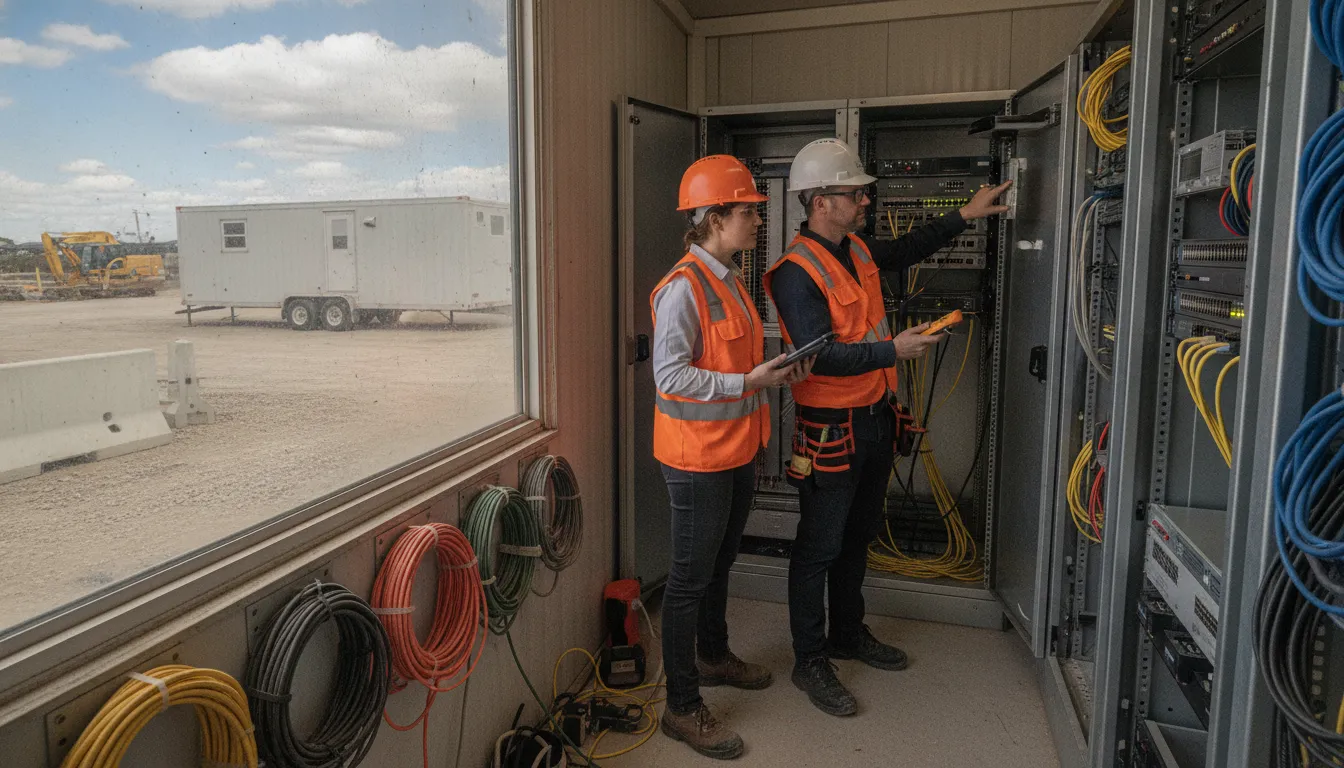
Answer: Managed IT for construction companies combines proactive monitoring, security, backup and recovery, responsive support, technology procurement, and field-to-office connectivity. The right scope should map directly to the firm’s project software, jobsite realities, recovery needs, and applicable compliance requirements.
How Managed IT Reduces Construction-Specific Business Risks
Construction technology connects estimating, accounting, project management, document control, and field communication. When those systems fail, the impact is not limited to an IT help desk ticket. Crews may lose access to current plans, project managers may miss updates, and office teams may work from information that is no longer accurate. Managed IT reduces that exposure by treating technology reliability as an operating requirement rather than a series of emergencies.
Preventing jobsite connectivity failures
Field teams need dependable access to cloud applications, shared files, scheduling tools, and communication platforms. Proactive monitoring can identify failing equipment, connectivity degradation, unusual access patterns, and capacity issues before they interrupt project work. A managed provider can also document the environment across offices, trailers, and remote locations, making it easier to standardize configurations and troubleshoot problems quickly. That consistency matters when a construction company adds a jobsite, moves an office, or brings another project team online.
Protecting bids, plans, and project data
Bid documents, contracts, financial records, schedules, and design files are valuable business information. Consistent backup and tested recovery procedures help limit the damage from hardware failure, accidental deletion, or a security incident. Security controls such as managed endpoint protection, access management, patching, and monitoring add additional layers of defense. Computek’s cybersecurity services for construction firms can support this broader risk-reduction approach.
Outsourcing IT does not transfer all responsibility to the provider. CISA emphasizes that MSP relationships require collaborative risk management including clear responsibilities, access controls, and oversight. The agency recommends proactive consideration of cybersecurity risks when organizations use managed service providers.
Keeping business software aligned
Construction firms often depend on connected ERP, estimating, accounting, payroll, and project-management systems. Unmanaged integrations can create duplicate entry, inconsistent records, and delays between the field and the office. A managed IT partner can maintain documentation, coordinate vendor support, and monitor the systems that keep information moving through the business. NIST research on design and information technology found that projects benefit from reliable technology implementation, not simply purchasing another application.
Answer: For construction companies, proactive monitoring, reliable backup, security controls, and coordinated software support reduce the likelihood that an avoidable technology issue becomes a project disruption. Prevention generally costs less than recovering from lost data, delayed communication, or field rework, making managed IT a practical risk-control investment.
How to Choose the Right Managed IT Partner for Your Construction Business
The right provider should understand how construction firms operate across offices, jobsites, and remote teams. A general helpdesk may resolve a password issue, but construction companies need dependable support for project management platforms, estimating and accounting systems, file access, and the connectivity that keeps field and office staff aligned.
- Prioritize local, responsive support. Local presence matters when a problem cannot be resolved remotely. A provider serving Georgetown, Round Rock, Pflugerville, and North Austin can evaluate office networks, support field-office connectivity, and provide on-site assistance when the situation warrants it. Ask how support is delivered, who responds to urgent issues, and whether the service model includes defined response targets rather than informal promises.
- Look for construction and software expertise. Ask prospective partners about their experience with construction, engineering, and manufacturing businesses. They should be able to discuss the systems your team depends on including estimating, accounting, document management, and project management software. More importantly, they should explain how they monitor those systems, protect access, manage updates, and coordinate troubleshooting without disrupting active projects.
- Evaluate proactive monitoring, not just emergency repair. A strong managed service partner identifies performance, security, backup, and connectivity issues before they become project interruptions. Request a clear explanation of monitoring practices, backup verification, security oversight, ticket escalation, and reporting. Understand what is included in the recurring service and which work may create additional charges.
Computek has served Central Texas small and midsize businesses for more than 25 years. Learn more about managed IT services for construction and industrial businesses and compare the provider’s capabilities with your firm’s operational requirements, geographic coverage, and growth plans.
Contact Computek to discuss your construction firm IT needs
Answer: The best partner combines local availability, construction-specific software knowledge, measurable response times, and proactive monitoring. Choose a provider that can support both office and field operations, not one that only responds after a disruption occurs.
Frequently Asked Questions
How do managed IT services reduce IT costs for construction firms?
Managed IT replaces much of the unpredictability of break-fix support with a defined monthly agreement. Instead of absorbing emergency response charges, repeated troubleshooting, and the operational cost of downtime, a construction firm budgets for ongoing monitoring, maintenance, and support. The exact fee depends on users, devices, project locations, and technology complexity, so the provider should explain what is included and what falls outside the agreement.
What do managed IT services typically include for construction clients?
Typical services include helpdesk support, proactive monitoring, cybersecurity management, network administration, backup and recovery, and hardware and software procurement. For construction firms, the service should also address secure connectivity between offices, jobsites, and remote teams. Ask whether the agreement covers the project management, estimating, accounting, and collaboration systems your staff actually uses rather than accepting a generic list of tools.
How do managed IT services help protect construction project data?
A managed provider can centralize security controls, monitor systems, maintain backups, and help establish recovery procedures for project files and business applications. That support improves preparedness, but outsourcing does not remove the company’s responsibility for risk decisions. The provider and construction firm should define access controls, backup retention, incident response responsibilities, and how security requirements will be reviewed as projects and systems change.
Why is construction-specific IT support better than generic support?
Construction teams rely on a mix of office systems, field connectivity, specialized estimating or project-management software, mobile devices, and shared project data. A provider familiar with that environment can prioritize issues based on schedule and field impact, plan around active projects, and coordinate support between office and jobsite teams.
What is the first step in evaluating a managed IT provider?
Start by documenting the systems your firm depends on: estimating software, project management platforms, accounting tools, file sharing, and jobsite connectivity requirements. Then ask each prospective provider how they would support each system, what proactive monitoring covers, what response times are guaranteed, and how cybersecurity and backup are handled. Request a written scope of work and compare it against your current technology expenses.
Ready to Schedule a Free IT Consultation?
Construction firms in Georgetown, Round Rock, Pflugerville, and North Austin rely on Computek for managed IT services that keep office and jobsite operations connected and supported. The right technology partner helps your team reduce downtime, control IT costs, and focus on completing projects on time and on budget.
Schedule a free IT consultation for your construction firm today to discuss how managed IT can support your specific operations, project requirements, and growth plans.