
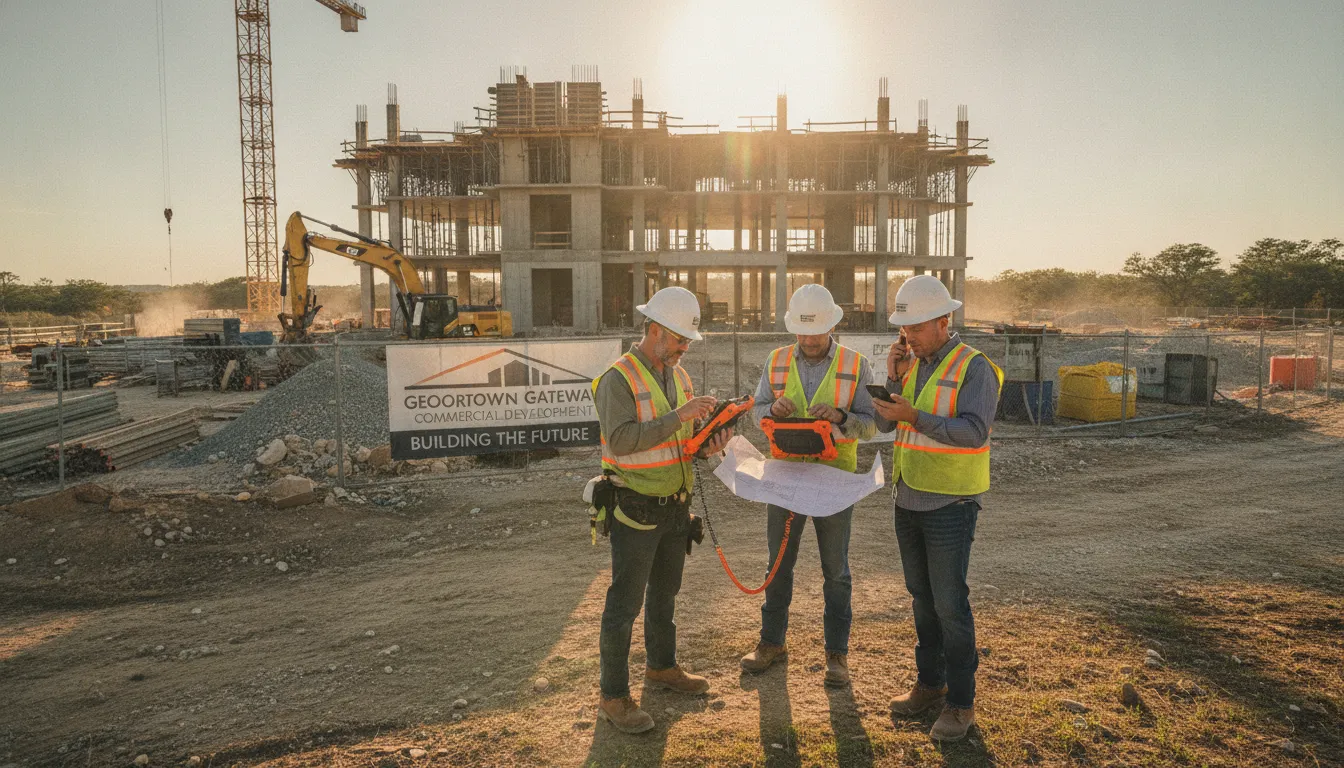
Construction firms in Georgetown face a persistent challenge: keeping field crews, project managers, and the home office connected when every job site has its own set of obstacles. Concrete walls, steel framing, heavy equipment noise, and sprawling site layouts all interfere with standard phone service. Traditional landlines and basic cell phones were never designed for these conditions. For firms managing projects in Georgetown, Round Rock, and Pflugerville, the communication gaps created by inadequate phone systems lead directly to costly project delays and missed subcontractor calls.
Ready to eliminate communication breakdowns on your job sites? Call Computek at (512) 869-1155 for a free 15-minute consultation on rugged VoIP systems built for Georgetown construction.
Standard cell phones fail in the middle of a pour or framing phase. VoIP systems designed for construction environments solve those problems. The sections that follow walk through the specific communication barriers that cost construction firms money. The features that directly address them, and a practical deployment plan for Georgetown-area contractors.
VoIP for construction companies replaces fragile desk phones with rugged, weather-resistant devices and mobile apps that work reliably on active job sites. These cloud-based systems route calls across field crews, dispatch teams, and office staff using existing internet connections. For Georgetown construction and engineering firms, the key advantages are hardware built to survive dust and drops, mobile apps that keep workers reachable anywhere on site. Auto-attendants that ensure no subcontractor call goes unanswered, and local support from a Georgetown-based IT team that can respond within hours.
VoIP for Construction Companies: Communication Challenges on Construction Sites
Construction projects in Georgetown, Round Rock, and Austin move at a relentless pace. Teams depend on real-time coordination to maintain schedules and prevent costly rework. Yet many firms operate with phone systems that are fundamentally misaligned with the conditions of active construction environments. Dust infiltration, heavy equipment noise that routinely exceeds 85 decibels, and sprawling site layouts render ordinary office phones useless in the field. When field crews cannot reach the office, work slows down and subcontractors sit idle waiting for direction. Industry data from the Construction Industry Institute indicates that rework caused by miscommunication consumes 5 to 10 percent of total project budgets across the sector. With Central Texas commercial builds experiencing an average of 3 to 5 coordination-related delays per month.
Noisy job sites make it difficult to hear critical instructions. If a crew member misses a detail during a concrete pour or steel erection sequence, the mistake gets baked into the structure at enormous cost. Standard cell phones lack the speaker power and noise cancellation needed to function around operating heavy equipment. Rugged job site communication tools address this by coupling high-output speakers with noise-filtering microphones engineered for industrial environments.
Dead zones and spotty signals
Many build sites in Williamson County have weak or inconsistent cellular signals. Metal rebar, concrete forms, and steel decking block radio waves from reaching workers inside partially completed structures. This creates dead zones where field crews lose touch with the main office for hours at a time. In a Georgetown commercial build, a three-hour communications blackout while rebar is being tied can mean the wrong grade of material gets placed, requiring a costly tear-out. Mobile VoIP applications running over a dedicated Wi-Fi or mesh network on-site can bypass these dead spots entirely.
Fragile gear in harsh environments
A standard desk phone or consumer-grade smartphone will not survive more than a few weeks on an active construction site. Silica dust infiltrates ports and speakers. Direct sunlight degrades screens and batteries. Drops onto concrete or into mud are routine occurrences. Purpose-built communication hardware for the construction industry features reinforced shells, IP65 or higher ingress protection against dust and water ingress. And speakers capable of delivering clear audio at 85-plus decibel ambient noise levels.
- IP65-rated housings that seal out fine silica dust and rain.
- Reinforced corner bumpers that survive drops from ladder height.
- High-output speakers with active noise compensation for loud sites.
- Extended batteries lasting 16 to 20 hours to cover full work shifts without midday charging.
Consumer phones fail in these environments, stopping communication and stalling the work day. Rugged VoIP handsets are engineered to take repeated impacts and keep functioning. They feature sunlight-readable displays and oversized buttons operable with gloved hands. For Georgetown construction firms running multi-phase projects, this equipment keeps the crew connected through every phase without equipment failures at critical moments.
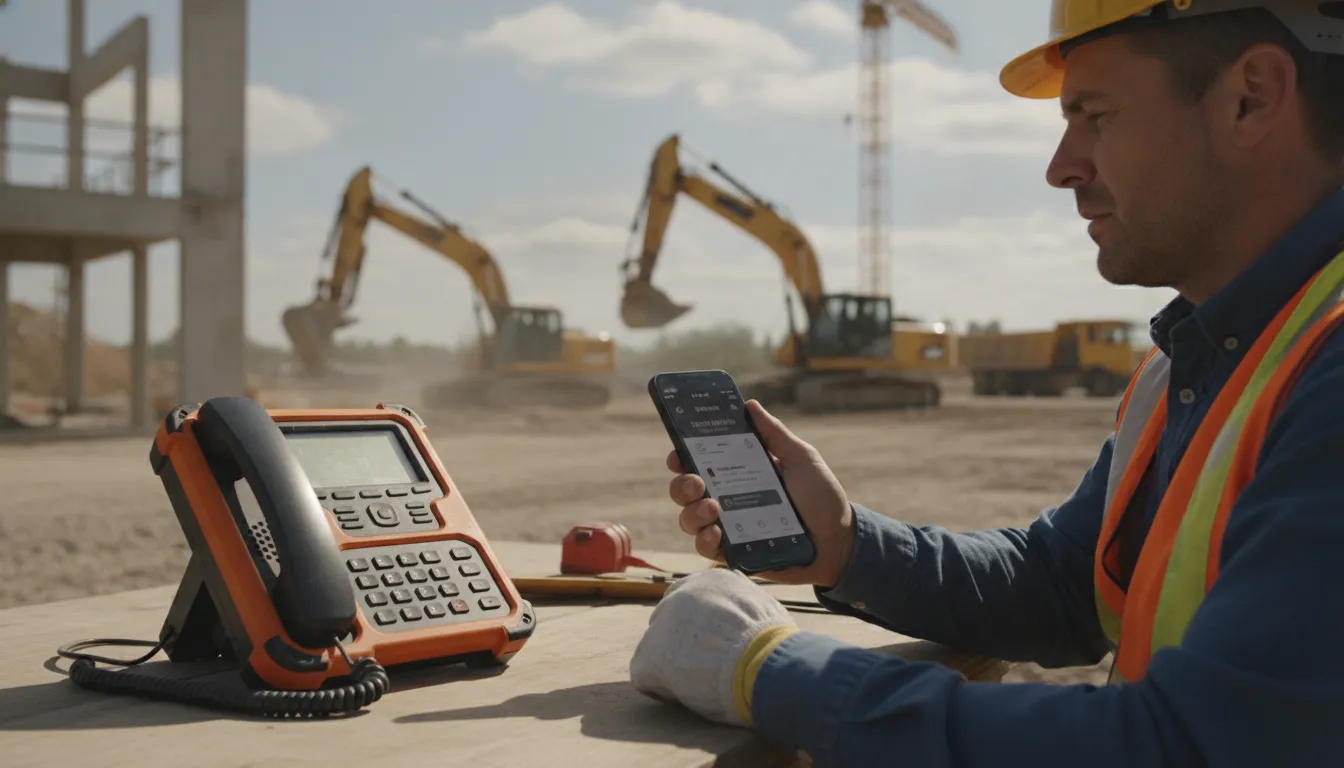
Construction sites in Georgetown and Central Texas create three recurring communication breakdowns: ambient noise levels that drown out standard voice calls. Structural dead zones where concrete and steel block cellular signals, and fragile consumer-grade equipment that fails when exposed to dust and moisture. Each of these issues costs construction firms an estimated 2 to 5 hours of lost productivity per week per site due to coordination delays.
What Makes VoIP Systems Better for Construction Than Traditional Phone Lines?
Lower monthly operating costs
Selecting the right phone system has a direct impact on a construction firm’s bottom line. Many Georgetown-area contractors still run legacy landline systems that carry high per-line fees, long-distance surcharges, and maintenance contracts for aging PBX hardware. Switching to a cloud-based system eliminates these recurring costs. The typical construction firm saves between 40 and 60 percent on monthly telecommunications expenses by moving to VoIP because calls route over the existing internet connection rather than the public switched telephone network.
Legacy systems also require significant capital investment in on-premise hardware such as a PBX cabinet, channel banks, and copper termination blocks. With cloud VoIP, the infrastructure lives in the provider’s data centers. The contractor pays a predictable per-seat monthly fee and nothing for hardware replacement. A new job site can be online with full phone service in hours rather than waiting days for the phone company to install new copper circuits.
Extended field reach beyond the office
Construction work happens in the field, not at a desk. Landline phones are physically locked to one location. When the project superintendent is walking the site, every call to the office number goes unanswered or to voicemail. Rugged VoIP platforms let every member of the team take their office extension with them via a mobile app. Subcontractors calling the office number reach the superintendent on his cell phone, and the caller sees the office number on caller ID. This maintains a professional appearance while enabling true mobility.
Job site wireless networks carry both voice and data traffic simultaneously. A superintendent reviewing structural drawings on a tablet can take a call from the architect without switching devices. Every minute on site becomes more productive when communication and information tools work together on a single connection.
Smart call routing and management tools
Traditional phone systems handle one function: connecting a call from point A to point B. Modern business VoIP platforms include an array of productivity tools that directly benefit construction operations. Auto attendants greet callers with a professional menu and route them to the correct department or job site. Ring groups ensure that when a subcontractor calls about a delivery window, every member of the relevant team receives the call simultaneously. This dramatically reduces missed connections.
These platforms scale instantly. When a Georgetown firm wins a new project and needs to add five field users. The administrator logs into a web portal and provisions the extensions in under five minutes. For growing construction firms that add crews and job sites throughout the year, this agility translates into competitive advantage.
| Feature | Rugged VoIP | Traditional Phone System |
|---|---|---|
| Monthly cost per user | $15 to $30 per user | $40 to $80+ per user |
| Field mobility | Mobile app on any smartphone | Desk phone only |
| Call routing | Auto attendant, ring groups, queues | Basic hold and transfer |
| Hardware durability | IP65 rugged handsets available | Standard office phones |
| New site setup time | Hours via self-service portal | Days to weeks, technician required |
VoIP systems outperform traditional landlines for construction firms on three fronts: cost savings of 50 percent or greater by eliminating copper line fees. Flexibility through mobile apps that turn any smartphone into a job site extension, and call management features such as auto-attendant routing, ring groups, and after-hours forwarding. Traditional phone systems require dedicated copper lines per desk, expensive PBX hardware, and on-site maintenance contracts.
Key VoIP Features That Support Georgetown Job Site Operations
Field crew mobile applications
Construction personnel rotate between multiple job sites throughout a single day. Mobile softphone applications let them access the full office phone system from any internet-connected location. Field workers can make and receive calls using their office extension and join conference calls with the design team. This real-time link between field and office reduces the coordination lag that causes rework and schedule overruns.
When a framing crew discovers a dimensional discrepancy at 8:00 AM. They place a single call through the mobile app that reaches the project engineer, the supplier, and the general superintendent simultaneously via ring group. The issue is resolved before the concrete truck arrives at 10:00 AM, avoiding a costly change order. Without VoIP-enabled field mobility, the same communication chain would require multiple phone calls and hours of lost productivity.
Auto attendant and ring group configurations
A missed call from a material supplier or subcontractor can delay an entire project phase. Auto attendants function as a digital receptionist that never takes a break. Callers hear a professionally recorded menu and are routed to the correct department, job site trailer, or individual extension based on their selection. For construction firms managing multiple active projects. This ensures that every inbound call reaches the person who can act on it rather than disappearing into a general voicemail box.
Ring groups add another layer of reliability. A single inbound number can ring every member of the dispatch team, the project superintendent, and the field foreman simultaneously. Whoever answers first takes the call. This configuration virtually eliminates missed calls during critical phases of construction when delays can push a project timeline by days or weeks.
After-hours routing and voicemail-to-email
Construction projects operate on schedules that extend well beyond normal business hours. Foundations are poured at dawn. Inspections happen at dusk. When urgent issues arise outside office hours, an auto-routing rule can forward calls to the on-call project manager’s mobile device without revealing their personal number. Voicemail-to-email converts every voice message into an audio file and sends it directly to the recipient’s inbox. A project manager walking a site in Georgetown can check messages without calling into the office voicemail system.
Construction-specific VoIP features that directly impact field operations include field crew mobile apps that keep every worker reachable on the office phone system from any location. Auto-attendant and ring group configurations that ensure subcontractor calls are never missed. And after-hours routing with voicemail-to-email so project managers stay informed of urgent issues without being chained to a desk.
How Does Local Support Improve VoIP Reliability for Construction Firms?
Same-day on-site support for active job sites
When a phone system fails at an active construction site, the cost compounds with every hour of downtime. Subcontractors cannot coordinate deliveries. Project managers lose contact with inspection teams. Safety communications are compromised. A national VoIP provider might offer phone support with a 24 to 48 hour SLA for on-site visits. But for a Georgetown construction firm, that delay can mean entire days of lost productivity.
A local provider with technicians based in Williamson County can offer same-day site visits to active jobs in Georgetown, Round Rock, Pflugerville, and North Austin. When equipment fails, someone who understands the specific needs of construction environments arrives with replacement hardware and gets the system back online before the next shift starts.
Knowledge of local network infrastructure and regulations
Georgetown’s telecommunications infrastructure is not uniform. Fiber availability, last-mile copper quality, and ISP coverage vary significantly between the downtown area, new developments, and outlying construction sites. A local IT provider knows which ISPs deliver reliable service to specific addresses and can design VoIP systems that account for the actual bandwidth and latency characteristics of each location.
Local building codes and municipal permitting requirements in Williamson County also affect how communication infrastructure is deployed on job sites. A local provider understands which installations require permits and what safety regulations apply to temporary communication lines on active construction sites.
Strategic technology partnership for growing firms
Construction firms that grow from 15 employees to 50 employees over a few years face entirely different communication needs at each stage. A local IT provider who visits the office regularly can recommend technology upgrades before capacity constraints cause problems. For Georgetown construction, engineering, and manufacturing firms, the value of a local technology partner like Computek extends beyond phone system maintenance to cybersecurity, data backup, and network infrastructure management.
Georgetown construction firms benefit from local VoIP support in three specific ways: same-day on-site response when phone systems fail at active job sites. Deep knowledge of local internet infrastructure and building codes in Williamson County. And a long-term partnership model where the IT provider understands the firm’s growth trajectory and plans technology upgrades proactively rather than reactively.
Steps to Deploy VoIP Across Construction Job Sites
Assess current site communication needs
Start by auditing how each crew currently communicates. Map the locations where cellular coverage drops or noise levels exceed what standard handsets can handle. Document current call flows and where breakdowns routinely occur. Interview project superintendents and foremen about their biggest communication pain points. In Georgetown construction operations, the most common complaints involve missed subcontractor calls during active work phases and inability to reach the office from inside steel-frame structures.
Verify network capacity at each location
VoIP call quality depends entirely on the underlying internet connection. Before deploying phones at any job site, test the available bandwidth, latency, jitter, and packet loss. A busy site with five to ten simultaneous users needs a symmetric connection of at least 10 Mbps. Many temporary construction site offices rely on LTE-based internet connections that may not provide consistent throughput. Quality of Service (QoS) configuration is critical when voice and data share a single connection.
- Conduct a site walkthrough. Identify dead zones, measure ambient noise levels, and mark locations for access points and VoIP handsets.
- Select rugged devices for field use. Choose handsets with IP65 or higher ingress protection and speakers rated for high-noise environments.
- Configure auto-attendant menus and ring groups. Map every inbound call path so subcontractors reach the correct person on the first attempt.
- Pilot the system on one active site. Run the deployment on a single job site for two weeks before expanding.
- Train every user on the new system. Cover mobile app installation, call transfer, and operation in high-noise environments.
Execute a phased site-by-site rollout
Begin the transition at the main office where conditions are controlled. Once office staff are comfortable with the new platform, extend deployment to the first pilot job site. After the pilot confirms the system meets requirements, roll out to remaining sites one at a time. Each new site deployment should be completed during a non-critical phase of construction to avoid disrupting active work. Within six to eight weeks from the initial office deployment, a firm managing five to eight active sites can have full VoIP coverage across the entire operation.
Deploying VoIP across construction job sites follows a five-phase sequence: assess current site communication gaps and cellular dead zones, verify network capacity for voice traffic at each location. Select rugged handsets rated for the construction environment, configure call routing rules including auto-attendant and ring groups. And execute a phased rollout starting at the main office before extending to individual job sites.
VoIP Considerations for Engineering and Manufacturing Firms
HD audio for technical design collaboration
When engineers discuss CAD model revisions or material specifications over the phone, every word carries financial risk. A misheard dimension can result in fabricated components that do not fit, requiring weeks of rework. HD Voice codecs available on modern VoIP platforms deliver audio bandwidth roughly double that of traditional phone lines, making subtle distinctions in numbers and technical terms dramatically clearer. Conference calls involving design teams and fabrication shops become significantly more productive with studio-quality clarity.
Shop floor and production environment integration
Manufacturing and fabrication environments present communication challenges similar to construction sites: high ambient noise, airborne particulates, and the need for glove-compatible operation. VoIP systems designed for industrial settings include overhead paging interfaces, rugged cordless handsets, and integration with existing plant-wide intercom systems. When a design change needs to reach the production floor immediately, the engineer places a call that triggers an overhead page and alerts the production supervisor’s handset simultaneously.
Multi-location team connectivity
Engineering firms frequently operate across multiple sites. Cloud-based VoIP makes these disparate locations function as a single organization. Employees can look up any colleague by extension regardless of physical location and transfer calls between sites with zero friction. For firms managing both office teams and remote field operations across Cedar Park and Georgetown, this unified communication layer reduces coordination overhead significantly.
Engineering and manufacturing firms in Central Texas face distinct VoIP requirements: high-definition audio for technical design discussions where every specification matters. Integration with shop floor environments where rugged handsets and overhead paging systems are essential. Multi-location team coordination across offices and plants, and unified communication that ties phone systems directly to project workflows.
Frequently Asked Questions
How much can construction companies save by switching to VoIP?
Construction firms typically save between 40 and 60 percent on monthly telecommunications costs after migrating from traditional landline systems to VoIP. These savings come from eliminating per-line fees, long-distance charges, and PBX hardware maintenance contracts. A firm with 25 users can expect annual savings of $7,500 to $15,000 depending on their current carrier rates and feature requirements.
What is the best VoIP phone for noisy construction environments?
For active construction sites, look for handsets rated IP65 or higher for dust and water resistance. Equipped with high-output speakers and noise-canceling microphones rated for ambient noise levels up to 90 decibels. Leading models include the Yealink SIP-T58A Pro and Grandstream GXP2170 paired with ruggedized handsets. Mobile softphone apps on smartphones with rugged cases also serve field crews effectively.
How quickly can VoIP be deployed on a new job site?
A new job site can be operational with full VoIP service within hours, provided the site has a stable internet connection. The provider provisions extensions through a web portal, and field crews install pre-configured handsets or activate mobile apps on the same day. This contrasts sharply with traditional landline installations that require copper pair provisioning and technician visits taking days or weeks.
Can VoIP systems integrate with construction project management software?
Yes, modern VoIP platforms integrate with project management tools such as Procore, PlanGrid, and BuilderTREND through API connections. These integrations enable click-to-call from within project dashboards, automatic call logging against specific work orders, and syncing of contact directories between the phone system and project management platform.
Does VoIP work during power outages on construction sites?
VoIP systems require power for on-site equipment such as switches, access points, and handsets. However, centralized VoIP infrastructure hosted in the cloud remains operational as long as the internet connection is active. Battery-backed PoE switches and UPS units for on-site networking equipment can maintain phone service through short-duration power interruptions. Additionally, VoIP disaster recovery planning can ensure call forwarding to mobile devices when the on-site network goes down.
Ready to Build a More Reliable Job Site Communication System?
Every day your construction firm operates with outdated phone systems, you lose money to coordination delays and missed subcontractor calls. These costs are predictable and preventable. A purpose-built VoIP system designed for construction environments eliminates the communication gaps that erode project margins and keeps every member of your team connected from the office to the most remote job site. Contact Computek today to schedule your free 15-minute consultation and learn how rugged VoIP solutions can transform your Georgetown construction operations.