
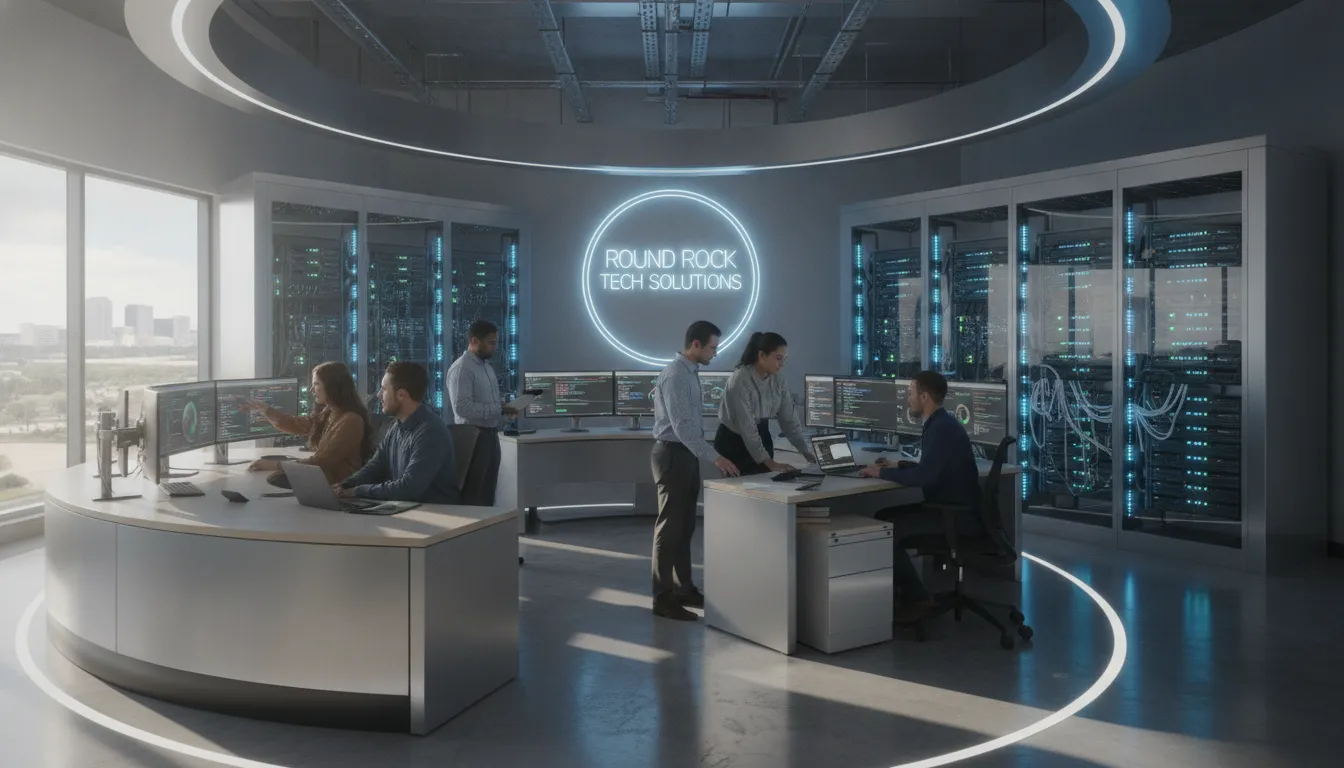
High IT staff turnover is forcing Round Rock engineering firms to rethink their technology management. Balancing internal control with expert backup is now a competitive necessity for local teams.
Schedule a free IT consultation with Computek by calling (512) 869-1155.
Co-managed IT services in Round Rock provide a flexible model for engineering teams to retain their lead IT staff while transferring routine monitoring and maintenance to external experts. This hybrid approach allows firms to maintain a lean in-house department focused on strategic technology planning while leveraging a partner’s 24/7/365 network operations center. Security operations center, and help desk. By contrast, fully outsourced IT transfers the entire technology burden to a managed services provider. It functions as a complete IT department without internal hiring. Both models eliminate the reactive break-fix cycle and unpredictable capital expenditures that plague growing engineering firms. However, they serve fundamentally different operational needs. Choosing the right path depends on how much control your engineering leadership wants to retain over daily infrastructure decisions and long-term technology roadmaps.
Many engineering leaders find it difficult to distinguish between these two models at first evaluation. Understanding how co-managed IT works in practice helps you determine whether it aligns with your firm’s operational workflow and risk tolerance. Let us examine the specifics.
Co-managed It Services Round Rock: What Are Co-Managed IT Services for Engineering Firms?
Co-managed IT is a hybrid service model that pairs your existing in-house technology staff with the infrastructure and expertise of an external managed services provider. In this arrangement, your internal team retains authority over strategic technology decisions, vendor relationships, and project roadmaps. The partner assumes responsibility for routine network monitoring, patch management, endpoint protection, help desk escalation, and around-the-clock security surveillance. This structure addresses a common pain point for engineering firms of 10 to 75 employees. It bridges the gap between needing full-time IT capabilities and being unable to justify a large internal team.
Contact Computek at (512) 869-1155 to discuss how co-managed IT can support your Round Rock engineering team.
Preserving Internal Oversight While Gaining Enterprise-Grade Support
Engineering firms that adopt a co-managed model retain a senior IT coordinator or director who knows the firm’s specific workflows, design software requirements, and compliance obligations. This person manages the relationship with the external provider and maintains authority over technology budgeting and long-term planning. The partner handles the operational load: server maintenance, security information and event management (SIEM), patch deployment, antivirus administration, and tier-1 through tier-2 help desk support. As noted in Computek’s managed IT provider guide, this model gives growing firms access to tools and staffing they could not otherwise afford while preserving institutional knowledge that resides in-house.
24/7 Monitoring Without Expanding Headcount
Many engineering and construction firms in Central Texas now maintain a lean internal technology staff of one or two leaders who focus on strategic initiatives. They partner with an external provider for continuous network monitoring, threat detection, and after-hours support. This structure provides access to a North American help desk that operates 24 hours per day, 7 days per week. It ensures that your managed IT services in Round Rock remain stable and responsive. Your internal team can rest knowing that certified engineers are monitoring the environment during evenings, weekends, and holidays.
Scaling Capacity on Demand
The co-managed model enables firms to scale their technology support up or down as project demands fluctuate. Adding new users, provisioning additional server capacity, or deploying new software across the organization becomes straightforward because the partner already knows your environment. This elasticity is particularly valuable for engineering firms that take on large public-sector or commercial projects requiring sudden infrastructure expansion. You can scale your Round Rock IT services without recruiting, interviewing, and onboarding new employees each time your workload increases.
Verdict: Co-managed IT is the optimal choice for Round Rock engineering teams that want to retain an in-house technology leader. It provides access to an external partner for 24/7 network monitoring, security operations, and scalable support capacity.
How Does Fully Outsourced IT Work for Engineering Teams?
In a fully outsourced model, your organization contracts with a managed services provider to act as its complete information technology department. The provider delivers all technology services: help desk, infrastructure management, security, compliance, procurement, and strategic planning. Think of it as having a full-time IT department without the recruiting burden, payroll overhead, or management liability of internal employees. Schedule a free IT consultation with Computek by calling (512) 869-1155 to explore your options.
Complete Infrastructure and Security Management
Fully managed providers assume responsibility for every layer of your technology stack. They handle routine patch management, firmware updates, antivirus signature deployment, data backup verification, and disaster recovery testing. They also monitor your environment for indicators of compromise using security information and event management platforms that correlate events across your entire network. The Cybersecurity and Infrastructure Security Agency emphasizes that organizations should ensure their managed service providers maintain robust security practices. A reputable partner documents their security controls, conducts regular penetration testing, and maintains compliance certifications relevant to your industry.
Predictable Operational Expenditure
One of the most compelling advantages of fully outsourced IT is the transition from unpredictable capital expenses to a fixed monthly operational cost. Your technology spending becomes a predictable line item in your operating budget. It is no longer a variable expense subject to emergency hardware replacements, ransomware remediation, or after-hours consulting rates. This budget predictability is especially important for engineering firms managing fixed-price contracts where cost overruns directly reduce margins.
Eliminating the Hiring and Retention Burden
Technology talent retention is a persistent challenge in Central Texas, where competition for skilled IT professionals drives turnover and salary inflation. Fully outsourced IT eliminates this entirely. The provider absorbs recruiting costs, background checks, training, benefits administration, and the productivity loss that occurs when a key employee gives notice. Your firm gains access to a team of specialists across multiple disciplines. You no longer rely on the limited skill set of one or two generalists. As Computek’s guide to managed IT providers explains, this model is particularly attractive for organizations that lack the scale to justify a full internal department but require enterprise-grade technology support.
Verdict: Fully outsourced IT is best suited for engineering firms with 10 to 75 employees that want to offload all technology responsibilities. It eliminates hiring risk and converts IT costs into a fixed monthly expense with defined service-level agreements.
Co-Managed IT vs. Fully Outsourced IT: Key Differences for Round Rock Firms
Choosing between co-managed IT and fully outsourced IT requires evaluating your firm’s current staffing structure, growth trajectory, and tolerance for technology management overhead. Each model offers distinct advantages depending on whether you have existing IT staff. How much control you require over infrastructure decisions, and what level of hands-on involvement your leadership team wants to maintain.
Call (512) 869-1155 or visit our contact page to discuss which model fits your engineering firm.
Control and Governance
The fundamental distinction is decision-making authority. Co-managed IT preserves internal governance: your IT director or technology lead approves architecture changes, selects software platforms, and manages vendor relationships while the partner executes the operational plan. Fully outsourced IT transfers this authority to the provider, who manages the entire technology environment according to agreed service levels and standard operating procedures. For engineering firms that handle sensitive design data or maintain specialized software environments, retaining internal governance may be critical for compliance and quality assurance.
Cost Structure Comparison
Both models improve cost predictability compared to reactive break-fix spending, but their composition differs. Co-managed IT involves two cost components: your internal IT salary and benefits plus the partner’s monthly service fee. Fully outsourced IT consolidates everything into a single monthly fee that covers all technology services, tools, and support. For firms without existing IT staff, the co-managed model may be more expensive because it requires hiring at least one internal coordinator. However, firms that already employ IT personnel will find co-managed IT less expensive than paying both the existing salary and a full outsourcing fee.
| Factor | Co-Managed IT | Fully Outsourced IT |
|---|---|---|
| Internal staff required | 1+ IT coordinator or director | None |
| Governance control | Internal team retains authority | Provider manages all decisions |
| Monthly cost composition | Salary + partner fee | Single all-inclusive fee |
| 24/7 monitoring included | Yes (via partner) | Yes |
| Security operations | Partner-managed with internal oversight | Fully provider-managed |
| Help desk staffing | Tier-1 internal, tier-2/3 partner | All tiers via provider |
| Ideal firm size | 10-75 employees with existing IT staff | 10-75 employees without IT staff |
Verdict: Choose co-managed IT when you have trusted internal technology staff and need specialized backup for complex infrastructure tasks. Choose fully outsourced IT when you want to eliminate all technology management responsibilities and convert IT to a fixed operating expense.
Why Round Rock Engineering Firms Require a Specialized IT Approach
Engineering, construction, and manufacturing firms in Round Rock, Georgetown, Pflugerville, and North Austin face unique technology demands. Generic IT models do not adequately address these requirements. These organizations depend on computer-aided design (CAD) software, building information modeling (BIM) platforms, finite element analysis tools, and project management systems. These tools require high-performance computing resources, low-latency networks, and minimal downtime.
Schedule a free IT consultation with Computek by calling (512) 869-1155 to evaluate your firm’s specific technology needs.
Supporting Specialized Engineering Software
Engineering workstations running Autodesk Revit, AutoCAD Civil 3D, SolidWorks, or similar applications demand significantly more processing power, memory, and storage throughput than standard office productivity tools. These applications generate large file sizes, require certified graphics drivers, and benefit from network configurations that minimize latency between workstations and file servers. When internal staff spend excessive time troubleshooting application performance, updating drivers, or resolving network bottlenecks, they divert attention from billable project work. Co-managed IT services can offload these infrastructure maintenance tasks while keeping software environment decisions under internal control.
Navigating the Local Technology Talent Shortage
Finding and retaining qualified IT professionals in Central Texas has become increasingly difficult as competition for technical talent intensifies across all industries. Engineering firms compete not only with other technology departments but also with pure-play technology companies, startup ventures, and remote-work opportunities that offer higher compensation. A co-managed or fully outsourced model provides immediate access to a team of certified professionals without competing in the local hiring market. This Round Rock IT services approach for engineering teams ensures you have the technical depth required to support complex operations without the recruiting overhead.
Cybersecurity Requirements for Design and Engineering Data
Engineering firms manage intellectual property in the form of design files, specifications, and proprietary methodologies that represent significant competitive value. A data breach or ransomware attack that encrypts these files can halt operations for weeks. It can also expose the firm to liability from clients whose confidential designs are compromised. The CISA guidance on managed service provider security underscores the importance of vetting your provider’s security posture. A qualified managed services partner implements endpoint detection and response (EDR), multi-factor authentication, security awareness training. And incident response planning tailored to the specific risk profile of engineering and construction firms.
Verdict: Round Rock engineering firms benefit most from co-managed IT when they have internal staff to oversee specialized software environments and retain control over security policies. Fully outsourced IT is a strong alternative for firms that prefer to delegate all technology and cybersecurity responsibilities to a qualified local partner.
How Much Does Co-Managed IT Cost Compared to Fully Outsourced IT?
The cost difference between co-managed and fully outsourced IT depends on whether your firm already employs internal technology staff and what level of service you require. Both models deliver cost advantages over the reactive break-fix alternative. However, their pricing structures reflect fundamentally different service delivery approaches.
Need help calculating your IT budget? Contact Computek for a free technology assessment.
Co-Managed IT Pricing Components
Co-managed IT pricing typically ranges from $50 to $150 per user per month depending on the scope of services. The number of covered devices, and the complexity of your environment. This fee covers remote monitoring and management (RMM), antivirus and endpoint protection, patch management, help desk escalation, and after-hours support. Your internal staffing cost is additive to this fee. For a firm paying one IT director a salary of $75,000 to $95,000 plus benefits and adding a co-managed partner at $75 per user per month for 25 users. The total annual technology cost would be approximately $110,000 to $130,000. The trade-off is full control over strategic decisions and the ability to maintain institutional technology knowledge internally.
Fully Outsourced IT Pricing
Fully outsourced managed IT services typically range from $100 to $200 per user per month for comprehensive coverage. This includes help desk, infrastructure management, security, compliance support, and vendor management. There are no additional staffing costs. For the same 25-user firm, the annual cost would range from $30,000 to $60,000. This is significantly less than the co-managed model. This lower cost reflects the provider’s operational efficiencies of scale and the elimination of internal IT salary expense. The managed IT services in Round Rock offered by local providers typically include all software licensing, monitoring tools, and security platforms within the per-user fee rather than charging separately for each component.
The Hidden Cost of Inadequate Technology Support
Both models should be evaluated against the cost of doing nothing. Unplanned downtime in an engineering firm can cost $5,000 to $15,000 per hour in lost billable productivity, missed deadlines, and client dissatisfaction. A single ransomware incident can cost $50,000 to $200,000 in recovery expenses, forensic investigation, legal fees, and reputational damage. Converting from reactive technology management to a proactive managed model eliminates these financial risks. It transforms IT from a budget uncertainty into a predictable operational investment. According to Computek’s managed IT provider guide, firms that adopt managed services typically reduce their annual technology costs by 20% to 35% compared to break-fix spending while gaining better security and reliability.
Verdict: Fully outsourced IT costs less per month because it consolidates all technology services into a single per-user fee with no internal staffing overhead. Co-managed IT costs more but preserves internal control. This may justify the premium for engineering firms with specialized software environments and compliance requirements.
How to Choose Between Co-Managed IT and Fully Outsourced IT
Selecting the right technology model requires a candid assessment of your firm’s current IT capabilities, growth plans, and leadership’s willingness to manage technology operations. The following framework will help you evaluate your options systematically.
Schedule a free IT consultation with Computek to identify the ideal technology model for your engineering firm.
Step 1: Audit Your Current Technology Workload
Begin by documenting how your internal staff spends their technology-related time over a typical month. Track hours spent on password resets, printer troubleshooting, server maintenance, software updates, security monitoring, vendor management, and strategic planning. If your technology lead spends more than 60% of their time on operational tasks rather than strategic initiatives, co-managed IT would free their capacity for higher-value work. If you have no internal technology staff and spend more than 10 hours per month on technology issues yourself. Fully outsourced IT will likely deliver better results at lower cost.
- Audit your current IT workload. Track how many person-hours per week your team spends on routine tasks such as user provisioning, password resets, and patch verification. If these tasks consume more than 15 hours per week, it is time to evaluate offloading them.
- Assess your internal team’s core competencies. Your staff may excel at CAD support and project management software but lack expertise in network security architecture, cloud infrastructure, or regulatory compliance. Identify the skill gaps that a partner would fill.
- Evaluate your growth trajectory. If you plan to add 15 or more employees or open a new office location within the next 12 months, factor in the technology scaling costs. Both co-managed and fully outsourced models scale more efficiently than hiring additional internal staff.
- Review your compliance obligations. Engineering firms working on public infrastructure, defense, or federally funded projects may have specific cybersecurity requirements under NIST SP 800-171 or CMMC. Ensure whichever model you choose can demonstrate compliance with these standards.
- Compare total cost of ownership. Calculate the fully loaded cost of your current approach including salaries, benefits, software licenses, hardware replacement reserves, emergency consulting fees, and downtime losses. Compare this against the per-user pricing from qualified local providers.
Step 2: Evaluate Partner Qualifications
Regardless of which model you choose, the quality of your managed services partner determines your outcome. Look for a provider with experience supporting engineering, construction, or manufacturing firms in the Round Rock and Central Texas region. Verify that they maintain security certifications such as SOC 2 Type II, employ certified engineers, and document their standard operating procedures. Ask for client references from firms of similar size and industry focus. A provider that understands your regulatory environment, software ecosystem, and operational tempo will deliver better results than a generalist with lower pricing.
Verdict: Firms with existing IT staff and specialized software environments should choose co-managed IT to preserve internal control while gaining expert operational support. Firms without IT staff that want predictable costs and comprehensive coverage should choose fully outsourced IT. In either case, partner selection matters more than model selection.
Frequently Asked Questions
What are co-managed IT services for engineering firms?
Co-managed IT services pair your existing internal technology staff with an external managed services provider. Your internal team retains authority over strategic decisions. The partner handles routine monitoring, maintenance, help desk escalation, and security operations. This model is ideal for engineering firms that want to offload operational tasks without losing internal control.
How do co-managed IT services differ from fully outsourced IT for Round Rock businesses?
Co-managed IT keeps your internal technology leader in place and supplements their capacity with external expertise. Fully outsourced IT replaces your entire internal technology function with a provider that delivers all services. The choice depends on whether you have existing IT staff and how much operational control you need to retain for your engineering workflows and compliance requirements.
Why choose a local managed IT provider in Round Rock, Texas?
A local provider understands the specific technology needs of engineering and construction firms in Central Texas. They know the software platforms common in the region, local compliance obligations, and the competitive dynamics of the Austin-area talent market. Local providers also offer the responsiveness of nearby staff who can provide on-site support when needed rather than relying entirely on remote assistance from a distant operations center.
How much do managed IT services cost for small engineering teams?
Co-managed IT typically ranges from $50 to $150 per user per month plus your internal staffing costs. Fully outsourced IT ranges from $100 to $200 per user per month with no additional staffing requirements. For a 25-person engineering firm, fully outsourced IT would cost approximately $30,000 to $60,000 per year. Co-managed IT would cost $110,000 to $130,000 per year including one internal IT director salary.
Can co-managed IT support specialized engineering software like AutoCAD and SolidWorks?
Yes. A qualified managed services partner familiar with engineering environments can optimize workstation configurations, manage graphics driver updates. Ensure file server performance meets CAD workload requirements, and provide help desk support for software-specific issues. Your internal staff retains control over software version selection and deployment timing while the partner handles the underlying infrastructure reliability.
Ready to support your Round Rock engineering team?
Your choice between co-managed IT and fully outsourced IT depends on your current staffing structure, control requirements, and growth trajectory. Computek provides both models to engineering, construction, and manufacturing firms throughout Round Rock, Georgetown, Pflugerville, and North Austin. Our local team understands the specific technology challenges facing Central Texas engineering organizations. We can design a support structure that aligns with your operational needs and budget.
Contact Computek online or call (512) 869-1155 to schedule a free IT consultation for your engineering firm.