
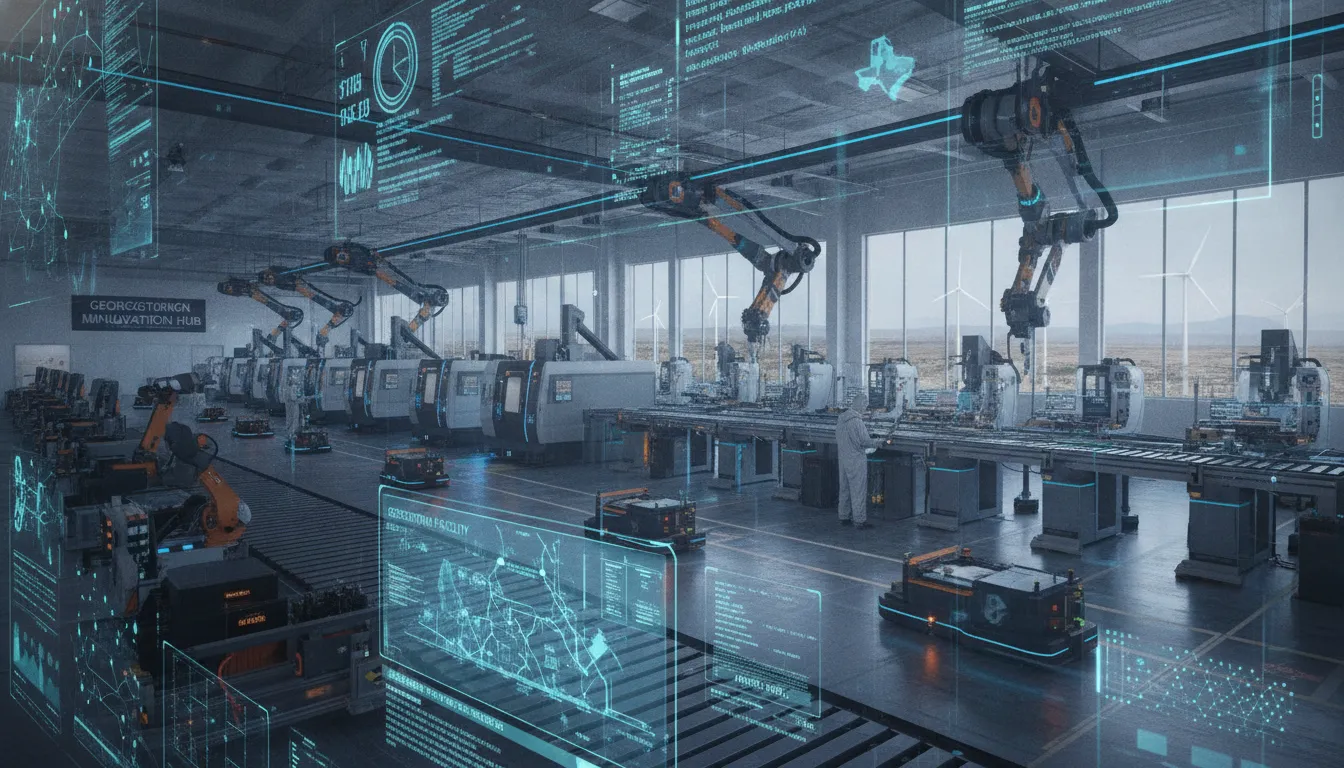
Manufacturing is the industry hit most by ransomware attacks. These online threats put local factory plants in Georgetown at high risk of high-cost shutdowns. Our experts help you secure your floor and prevent expensive downtime.
Schedule a free consultation with our team to protect your plant.
Cybersecurity for manufacturing companies combines network segmentation, continuous monitoring, and employee training to protect plant-floor OT systems from ransomware. These defenses follow the NIST Cybersecurity Framework and adapt to the specific threats facing industrial environments in Central Texas. With proactive measures, plant managers can stop attacks before they halt production lines.
Every factory plant in Central Texas faces online risks that grow as technology evolves. Understanding how these threats target industrial hardware is the first step toward building a stronger defense. Let us examine the most pressing cybersecurity challenges facing local manufacturers today.
What Are the OT Cybersecurity Challenges Facing Industrial Plants?
Operational technology (OT) systems run the heart of every industrial plant. These systems control robotics, assembly lines, and sensors that keep production moving. Many plants now face significant risks as they connect these legacy systems to the internet. Hackers target manufacturing aggressively because downtime costs far more than most other industries.
Industrial plants face three core OT cybersecurity challenges: legacy systems that cannot run modern security tools, the convergence of IT and OT networks that expands the attack surface, and the high cost of downtime that makes manufacturing a top ransomware target. Each challenge demands specific countermeasures.
Legacy systems and patching hurdles
Many factories use 10 to 20-year-old control systems that still perform well for production. These legacy systems often run outdated software lacking modern security capabilities. Keeping them secure is difficult because patching during work hours is rarely feasible. Taking a production line offline to update a programmable logic controller (PLC) can cost thousands in lost output, leaving a long window of exposure to known exploits.
Most OT hardware was designed for decades of service, not for defending against cyber attacks. These devices typically lack the processing power or memory to run contemporary security applications. Since they were originally air-gapped, they lack basic authentication controls found in corporate IT environments. For organizations needing help securing older assets, IT services tailored for manufacturing offer specialized legacy system protection.
The risk of IT and OT convergence
Plants used to keep their shop floor networks completely separate from office networks. Today, those boundaries have blurred to support better data analytics and automation. This IT-OT network convergence creates a substantially larger attack surface. A single phishing email in the administrative office can now provide a pathway to the factory floor. This reality makes comprehensive cybersecurity services essential to plant operations.
Industrial IoT devices introduce additional risk. Every connected sensor, smart tool, or monitoring endpoint represents a potential entry point. Many facilities add hundreds or thousands of these devices without evaluating their security posture. This rapid endpoint growth makes comprehensive asset discovery difficult. Without a clear map of every connected device, defending against lateral movement becomes nearly impossible.
Why manufacturing is a top target
Attackers target manufacturers because production stoppages create immense financial pressure to pay ransoms. The average cost of a ransomware-induced shutdown in manufacturing exceeds $5 million per incident, factoring in lost production, delayed shipments, and recovery expenses. Supply chain attacks have increased by over 200% as adversaries seek weak links in vendor networks. Protecting your plant now means safeguarding not just your own data but your entire supply chain.
The Verdict: Modern industrial plants must treat OT security as a core operational priority. Air-gapping and legacy hardware no longer provide adequate protection. A multi-layered defense combining network segmentation, asset discovery, and 24/7 monitoring is the most effective approach to stopping ransomware before it halts production lines.
How Do Ransomware Attacks Target Manufacturing Operations?
Ransomware represents the most significant cyber threat to manufacturing operations today. These attacks encrypt critical data and disrupt industrial control systems, forcing complete production stoppages. For manufacturing companies, the financial consequences of downtime typically far exceed the ransom demand, making these facilities prime targets. Understanding the attack sequence enables plant managers to build more effective defenses.
Ransomware attacks on manufacturing follow a five-stage kill chain: phishing delivers initial access, attackers steal credentials and escalate privileges, they map the network to locate OT systems, pivot from IT to OT through unsegmented connections, then deploy ransomware to halt production. Each stage presents an opportunity for detection and prevention.
Initial access through phishing
The majority of ransomware incidents begin with a phishing email. Attackers craft messages posing as legitimate shipping notifications, vendor invoices, or internal communications. When an employee clicks a malicious link or opens an infected attachment, the attacker gains an initial foothold. This is why comprehensive cybersecurity services must include robust email filtering and ongoing security awareness training as foundational controls.
Lateral movement and OT access
Once inside, attackers move laterally through the network, escalating privileges and mapping the environment. In many manufacturing facilities, the corporate IT network and plant-floor OT network share connectivity without proper segmentation. This allows attackers to pivot from a compromised workstation to the PLCs, SCADA systems, and robotic controllers driving production. Weak default credentials on industrial equipment and unpatched legacy systems create easy pathways for this lateral movement.
Production line disruption
The final and most damaging stage is deploying ransomware across both IT and OT systems. Attackers encrypt file servers, databases, and backup repositories, then disrupt control systems to maximize operational impact. A single incident can halt an entire assembly line, delay shipments, and compromise intellectual property. Industry data shows the average manufacturing ransomware incident causes over $5 million in downtime costs alone.
- Phishing delivery: A targeted email with a malicious attachment or link reaches an employee’s inbox.
- Credential theft: The attacker compromises login credentials and escalates privileges within the network.
- Network reconnaissance: The adversary maps the network topology, identifying OT assets and backup servers.
- IT to OT pivot: Gaining access to the OT network through unsegmented connections or shared credentials.
- Ransomware deployment: Encrypting critical data and control system configurations, triggering production stoppages.
Key Cybersecurity Measures for Georgetown Manufacturing Companies
Georgetown manufacturing companies face distinctive risks as they integrate digital systems into their factory operations. Protecting these industrial environments requires a comprehensive security program covering both office IT infrastructure and shop-floor OT systems. Computek delivers comprehensive cybersecurity services that establish multiple defensive layers to stop modern threats before they cause costly shutdowns.
Effective cybersecurity for Georgetown manufacturers combines multi-layered network security (firewalls, email filtering, dark web monitoring), proactive ransomware detection with 24/7 monitoring, and employee security awareness training. These three pillars create a defense-in-depth posture that protects both IT and OT environments.
Multi-layered network security
A strong defense starts at the perimeter. Manufacturers need firewalls, email filters, and dark web monitoring working together. Since phishing remains the primary initial access vector, email security is the critical first control for any industrial facility. Advanced network tools identify hidden risks and block them in real time before they reach production systems.
The National Institute of Standards and Technology (NIST) recommends a structured cybersecurity framework for manufacturing environments. Computek implements network segmentation to keep office traffic isolated from sensitive plant-floor controls. This separation ensures that a virus originating in the administrative network cannot propagate to robotics or assembly line controllers.
Proactive monitoring and ransomware detection
Modern ransomware spreads rapidly, making reactive alerting insufficient. Industrial facilities require 24/7 monitoring to identify anomalous behavior across the network. Computek employs enhanced ransomware detection that identifies early indicators of compromise, such as unusual file encryption patterns or unauthorized data exfiltration.
Business owners in Central Texas can leverage IT services tailored for manufacturing to implement these protective measures. These systems continuously monitor every segment of the network, from office workstations to shop-floor sensors and controllers. When a threat is detected, the system can isolate the affected device and initiate an automated response to maintain production continuity.
Employee security awareness training
Your workforce is simultaneously your greatest vulnerability and your strongest defense. Training employees to recognize phishing attempts and social engineering tactics is as important as deploying technical controls. Computek equips staff with the knowledge and procedures to identify suspicious activity and report it immediately.
Manufacturing-specific training addresses the risks of connecting personal devices to plant-floor networks and the importance of following proper incident reporting protocols. By cultivating a security-conscious culture, facilities can substantially reduce the likelihood of a successful breach. This human layer of protection works alongside technical controls to create comprehensive organizational defense.
Verdict: Multi-layered security is essential
Manufacturing plants cannot rely on a single firewall or antivirus solution. A combination of network segmentation, ransomware detection, and employee training is required to protect industrial uptime. Computek builds customized defensive layers to ensure Georgetown businesses remain productive and secure.

Why Local Expertise Matters for Georgetown Industrial Cybersecurity
When protecting industrial plants from ransomware, the geographic location of your cybersecurity partner matters more than many business owners realize. A local provider offers advantages that national or remote-only firms cannot match, particularly for manufacturing facilities with complex OT environments requiring hands-on support.
Local cybersecurity expertise provides three distinct advantages for Georgetown manufacturers: on-site response capability within hours rather than days, understanding of regional threat landscapes affecting Central Texas industries, and long-term relationships that build operational familiarity with specific plant equipment and processes.
On-site response capability
Industrial cybersecurity cannot be managed entirely remotely. When an incident occurs on a plant floor, having specialists who can arrive on-site within hours rather than days makes a critical difference. Computek is headquartered in Georgetown, Texas and has served Central Texas businesses for over 25 years. Their technicians can reach manufacturing facilities in Georgetown, Round Rock, or North Austin quickly to assess OT systems, contain threats, and begin recovery operations. Being a Georgetown-based IT provider means they understand the local industrial landscape intimately.
Understanding regional threats
Cyber threats vary significantly by region. A Georgetown-based provider understands the specific threat landscape facing Central Texas manufacturers, including which local industries are most targeted, what compliance requirements apply to Texas industrial facilities, and how regional infrastructure dependencies create unique risk profiles. This localized knowledge translates into more relevant threat assessments and more effective security controls tailored to the community.
Long-term relationships and operational trust
Industrial cybersecurity depends on trust. Plant managers need a security team that understands their specific production processes, equipment vendors, and operational constraints. Computek maintains client relationships spanning decades, with multiple organizations trusting the firm for 10 to 20 years. This continuity means technicians arrive already familiar with the facility layout, equipment configurations, and key personnel rather than spending valuable time getting oriented during an active incident.
For small to mid-sized manufacturing companies with 10 to 75 employees, choosing the right cybersecurity partner is especially consequential. National firms often apply standardized solutions that fail to account for the unique mix of legacy and modern equipment typical in smaller plants. A Georgetown MSP like Computek builds tailored solutions aligned with the specific budget, risk tolerance, and operational needs of local manufacturers.
Key takeaway: Local cybersecurity expertise provides faster incident response, regional threat awareness, and personalized service that national providers cannot match. For Georgetown manufacturers, partnering with a locally headquartered MSP is a strategic operational advantage.
Build a Resilient Cybersecurity Plan for Your Industrial Plant
Developing a comprehensive cybersecurity plan for a manufacturing facility is not a one-time project. It is an ongoing process that must evolve alongside production technology and the ever-changing threat landscape. Below are the essential components of a resilient cybersecurity strategy for industrial operations in Georgetown and Central Texas.
A resilient cybersecurity plan for manufacturing combines a recognized framework (such as NIST), network segmentation between IT and OT, verified offline backups, employee training, and partnership with a managed IT provider. Each component reinforces the others to create a defense-in-depth posture that substantially reduces ransomware risk.
Adopt a recognized security framework
Start with a proven framework such as the NIST Cybersecurity Framework, which provides guidance specifically adapted for manufacturing environments. The NIST framework organizes security activities across five core functions: Identify, Protect, Detect, Respond, and Recover. For industrial plants, this framework bridges the gap between conventional IT security standards and the unique operational requirements of OT systems.
DIY vs. Managed Cybersecurity: What Fits Your Plant?
| Approach | DIY / In-House | Managed IT Services Provider |
|---|---|---|
| Upfront cost | High (hiring, tools, training) | Predictable monthly fee |
| 24/7 coverage | Requires shift staffing | Built into service model |
| OT expertise | Hard to find and retain | Dedicated team with cross-industry experience |
| Incident response | Reactive, often slow | Rapid, practiced playbooks |
| Scalability | Requires new hires for growth | Scales with your business |
Segment IT and OT networks
Network segmentation between corporate IT and plant-floor OT networks is arguably the single most effective control available. When an attacker compromises a workstation through phishing, proper segmentation prevents that breach from reaching PLCs, SCADA systems, and robotic controllers. Without this separation, a single compromised credential can produce a full production shutdown.
Implement offline backup and tested recovery
Ransomware attackers now specifically target online backups. A resilient plan must include regular offline or immutable backups of both IT and OT system configurations. More importantly, disaster recovery procedures must be tested at least quarterly. A backup that has never been restored is a guess, not a plan. Data backup and disaster recovery solutions should be verified against real-world production recovery scenarios.
Invest in employee security awareness training
Employees remain the first line of defense. Manufacturing personnel may not be trained to recognize sophisticated phishing attempts targeting operational staff. Regular security awareness training tailored to industrial environments, covering OT-specific risks, social engineering tactics directed at plant-floor personnel, and proper incident reporting procedures, dramatically reduces the likelihood of successful initial access attacks.
Partner with a managed IT provider
For most mid-sized manufacturing companies in Georgetown, maintaining a full in-house cybersecurity team is not practical. Partnering with a managed IT provider like Computek provides access to 24/7 proactive monitoring, enhanced ransomware detection, vulnerability management, and incident response capabilities, all delivered by a local team that understands Central Texas industrial operations. Computek’s managed IT services with ransomware protection include SIEM monitoring, endpoint detection and response, and regular security assessments designed specifically for SMB manufacturers.
Key takeaway: A resilient cybersecurity plan combines framework adoption, network segmentation, verified backups, employee training, and expert managed security services. Each component reinforces the others to create a defense-in-depth posture that significantly reduces ransomware risk.
Secure your manufacturing plant today. Contact Computek for a free cybersecurity assessment.
What Should Manufacturers Do After a Cyber Incident?
Despite the best prevention efforts, every manufacturing plant should operate on the assumption that a breach may eventually occur. Having a clear incident response plan ready before an attack happens can mean the difference between a two-day disruption and a two-month shutdown. Here is the structured response that industrial facilities should follow.
An effective post-incident response for manufacturers follows four steps: contain and isolate affected systems immediately, activate the documented incident response plan, engage external experts for forensic analysis and recovery, and conduct a post-incident review to strengthen defenses against future attacks.
Contain and isolate affected systems immediately
The first priority is stopping the breach from spreading. This requires disconnecting affected systems from the network, including both IT and OT segments. In manufacturing environments, this may mean shutting down specific production lines or isolating PLCs and SCADA controllers showing signs of compromise. Speed is critical: ransomware can propagate from a single workstation to an entire plant floor in minutes.
Activate your incident response plan
A well-documented incident response plan should specify decision-makers, communication protocols for employees and customers, and which external resources to engage. This is where partnering with a managed IT provider like Computek delivers significant value. Computek has a track record of successfully recovering clients from ransomware incidents, applying proven containment and restoration procedures that minimize downtime.
Engage external cybersecurity experts
Unless your facility has a dedicated in-house security operations team, engaging external experts is essential for proper forensic analysis and recovery. Local providers can be on-site rapidly to assess OT system integrity, identify the root cause, and coordinate with law enforcement if required. Their experience across multiple incidents translates into faster, more effective recovery than an internal team attempting to handle an unprecedented situation.
Conduct a post-incident review
After recovery, a thorough post-incident review identifies the weaknesses that allowed the breach and defines corrective actions. This review should feed directly into updated security controls, revised employee training, and improvements to the incident response plan. Each incident, whether a full breach or a near-miss, is an opportunity to strengthen the facility’s overall security posture.
Frequently Asked Questions
How much does a ransomware attack cost a manufacturing company?
The average cost of a ransomware attack on a manufacturing company exceeds $5 million when factoring in downtime, lost production, recovery expenses, and potential ransom payments. Supply chain disruptions and delayed shipments add further financial impact.
What is the difference between IT and OT cybersecurity?
IT cybersecurity protects data, networks, and endpoints in office environments. OT cybersecurity protects the industrial control systems, PLCs, SCADA systems, and robotics that run physical production processes. OT security prioritizes uptime and safety over data confidentiality.
Can small manufacturers afford professional cybersecurity services?
Yes. Managed IT service providers offer cybersecurity at predictable monthly rates that are significantly more affordable than hiring a full in-house security team. For small to mid-sized manufacturers, this model provides enterprise-grade protection without enterprise-level overhead.
What is network segmentation and why does it matter for manufacturers?
Network segmentation divides a computer network into smaller, isolated sections. For manufacturers, it keeps office IT networks separate from plant-floor OT networks. This prevents a breach in the administrative network from reaching production control systems.
How often should manufacturers test their cybersecurity defenses?
Manufacturers should conduct vulnerability assessments quarterly, test backup restoration at least quarterly, perform employee security training annually with periodic phishing simulations, and schedule full penetration tests at least once per year or after major system changes.
Ready to secure your Georgetown manufacturing plant?
Ransomware threats to industrial facilities are not diminishing. Every day that passes without proper protections increases the risk of a costly production shutdown. Computek provides the local expertise, proven security frameworks, and 24/7 monitoring that Georgetown manufacturers need to protect their operations, employees, and bottom line.
Contact Computek today to schedule your free cybersecurity assessment.